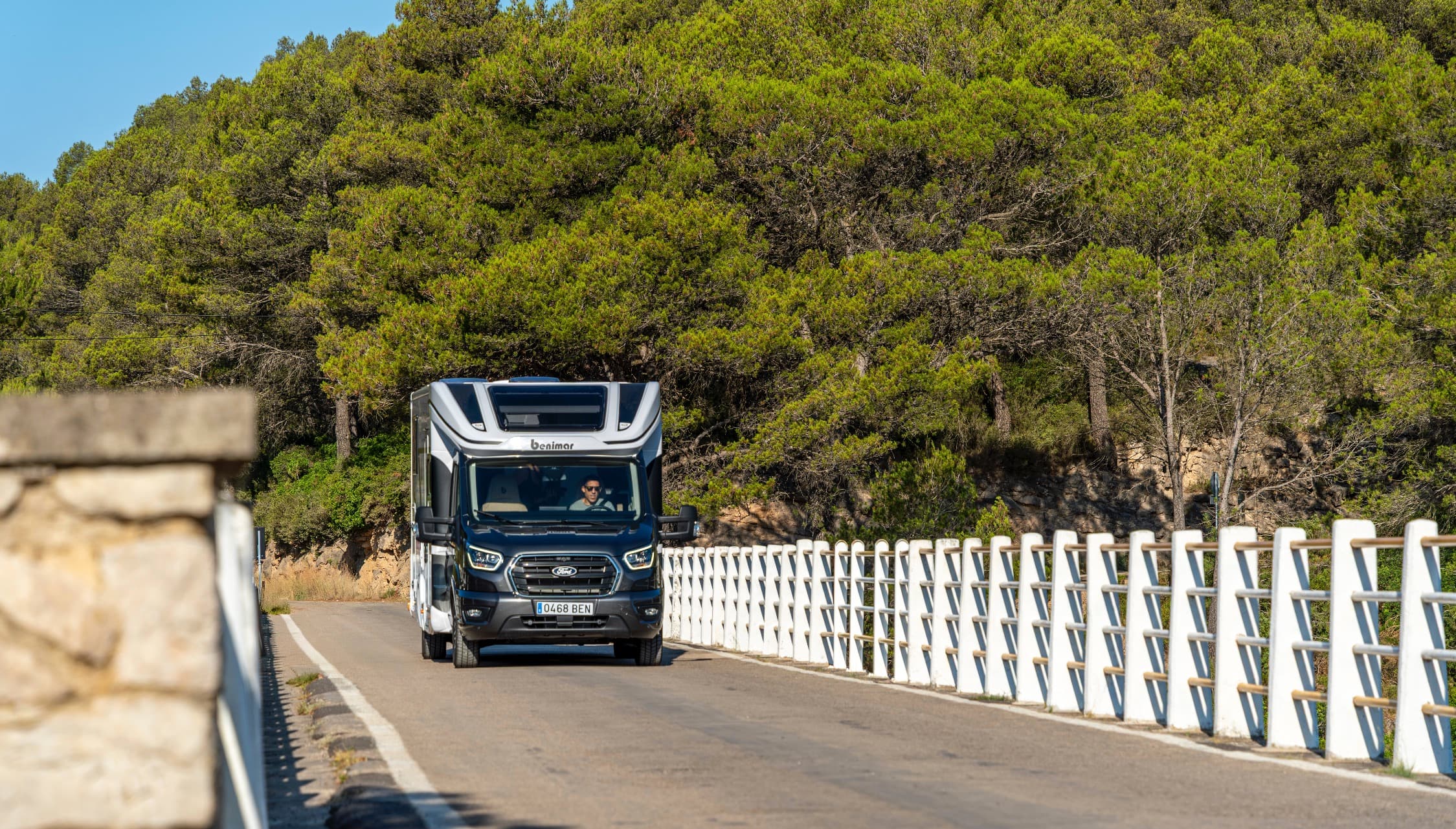
You can take our campers abroad. The rental contract allows this on condition that your destination country falls within the coverage area of the Green Card (third-party liability insurance) we issue. For any country not on that list, you will have to arrange and pay for insurance yourself. Once that is settled, the terms of your trip are set not by the camper itself but by three numbers in the vehicle registration certificate: the maximum permissible mass, the height and the number of seats. These three numbers determine your vignette category in Slovenia and Hungary and your toll class in Italy, France and Croatia. Vignettes for Austria, Czechia, Slovakia, Slovenia, Hungary and Switzerland can be bought online just minutes before you cross the border. Two documents, however, cannot be had that quickly: the German environmental sticker and the French Crit'Air certificate are sent by post, so getting them takes weeks, not minutes.
Every price, rule and fine below is listed together with the authority that published it in the sources at the bottom of the page, and all the data was checked on 2026-07-28. Where official figures contradict each other or where there is no national rule, we say so clearly in the text rather than give inaccurate data. Toll and vignette rates are reviewed every year, usually in January, so be sure to check them again before your trip.
Can you take a rented camper abroad, and what does the contract require?
The first thing your route depends on is the insurance document, not the vehicle itself.
Our contract allows travel abroad. We issue a Green Card (third-party liability insurance) that travels with the vehicle. Your job is to make sure that every country on your route is included in this document. If a country is not there, you will have to arrange and pay for insurance in that country yourself before crossing its border. A route through the European Union and the Schengen area usually causes no trouble, but once you head towards South-Eastern or Eastern Europe, this condition becomes especially important. This condition is published in our rules.
Two more contract terms are worth checking at the same time.
Mileage
The permitted mileage is set in your rental contract. A trip around Europe "eats up" distance much faster than any route in Lithuania, so read this figure in your contract carefully before you finalise your trip plan.
Comprehensive (KASKO) insurance and deposit
Comprehensive (KASKO) insurance is included in our rental price. At handover an 800 EUR deposit is held, which is returned when you bring the camper back clean and with a full fuel tank. The insurance cover works abroad exactly as it does in Lithuania, and our roadside assistance is available around the clock.
Renters almost always ask about the vehicle itself first: which camper suits a trip around Europe. The short answer is a semi-integrated camper with a mass of no more than 3,500 kg that can be driven on a category B licence. The long answer, covering the four body types and the arithmetic of sleeping places and seats with seat belts, is in the article which camper suits a trip around Europe. It is also the shorter of the two answers. The rules of the countries you drive through limit a trip around Europe far more often than the camper itself.
Which three numbers in the registration certificate determine every toll you pay?
Every European toll and vignette system classifies your vehicle. None of them does it "by eye", and you will not find two systems that use the same criterion. When you collect the camper, write down these three values from the vehicle registration certificate during the briefing and save them on your phone.
- Maximum permissible mass. Our campers can be driven on a category B licence, which means they do not exceed 3,500 kg. This fact alone lets you use the ordinary vignette systems in Austria, Czechia, Slovakia, Slovenia, Switzerland and Hungary. If the mass exceeded 3,500 kg, you would have to use the heavy vehicle systems: GO-Box in Austria, DarsGo in Slovenia, MYTO CZ in Czechia, SkyToll in Slovakia.
- Height. Four thresholds come up again and again in Europe: 1.30 m height above the front axle (Slovenia, Italy), 1.90 m overall height (Croatia) and 2 m and 3 m overall height (France). Every camper exceeds the lowest of them. This is the number that moves your vehicle out of the passenger car class.
- Number of seats. Hungary partly divides its vignette categories by the number of seats shown in field S.1 of the registration certificate. A camper with more than seven seats does not fall into the same category as one with seven. Our campers are designed for up to seven people, so in Hungary they fall into category D1, not D2. When you collect the camper, check your vehicle's figure in field S.1.
| Country | System | What determines the category | Where a camper up to 3,500 kg falls |
|---|---|---|---|
| Austria | Vignette | Maximum permissible mass only | Same category as a passenger car |
| Czechia | E-vignette | Maximum permissible mass only | Same category as a passenger car |
| Slovakia | E-vignette | Maximum permissible mass only | Same category as a passenger car |
| Switzerland | Vignette | Maximum permissible mass only | Same category as a passenger car |
| Slovenia | E-vignette | Height above the front axle, 1.30 m | Class 2B, double the passenger car price |
| Hungary | E-vignette | Vehicle category and number of seats (field S.1) | D1 up to seven seats, D2 above seven |
| Italy | Toll booths | Height at the front axle, 1.30 m | Class B |
| France | Toll booths | Overall height, 2 m and 3 m | Class 2 |
| Croatia | Toll booths | Overall height, 1.90 m | One class above a passenger car |
| Poland | Toll booths on three sections | Maximum permissible mass only | Free, except on three concession sections |
| Germany | No motorway toll up to 3,500 kg | Maximum permissible mass only | Nothing to pay |
Which vignettes do you need for a camper trip around Europe, and where do you buy them?
Buy the road tolls and motorway vignettes each country requires before you cross its border. All the systems listed below are now electronic and linked to your number plate, so buying one takes just a few minutes and there is no sticker to put on the windscreen. The exception is Austria and Switzerland, where a stick-on version still exists alongside the digital one.
Prices for vehicles up to 3,500 kg, taken from the operators or national authorities on 2026-07-28:
| Country | Short period | Month | Year | Where to buy |
|---|---|---|---|---|
| Austria | 12.80 EUR / 10 days | 32.00 EUR / 2 months | 106.80 EUR | asfinag.at |
| Czechia | 300 CZK / 10 days | 480 CZK / 30 days | 2,570 CZK | edalnice.gov.cz |
| Slovakia | 10.80 EUR / 10 days | 17.10 EUR / 30 days | 90.00 EUR | eznamka.sk |
| Slovenia, class 2A (passenger car) | 16.00 EUR / week | 32.00 EUR | 117.50 EUR | evinjeta.dars.si |
| Slovenia, class 2B (camper) | 32.00 EUR / week | 64.10 EUR | 235.00 EUR | evinjeta.dars.si |
| Hungary, D1 | 6,900 HUF / 10 days | 11,170 HUF | 61,760 HUF | nemzetiutdij.hu |
| Hungary, D2 | 10,040 HUF / 10 days | 15,820 HUF | 87,650 HUF | nemzetiutdij.hu |
| Switzerland | no short period | no monthly option | 40 CHF | bazg.admin.ch |
The Hungarian figures are taken from the official rate sheet published by Nemzeti Útdíjfizetési Szolgáltató under ministerial decree 45/2020, in force from 2026-01-01. Both rows matter for a camper: D1 applies to vehicles up to 3,500 kg carrying up to seven people, and D2 applies to vehicles of the same weight class with more than seven seats, and the difference in the ten-day price between them is 3,140 HUF.
For a week and for a year, Slovenia charges twice as much for a camper as for a passenger car, because the 1.30 m height threshold above the front axle puts every camper in class 2B. Austria charges the same 12.80 EUR for ten days for a camper and a passenger car, because it classifies vehicles by weight only. There is no single European logic here to learn. The eleven countries in the classification table sort campers by four different criteria: maximum permissible mass, height above the front axle, overall height and number of seats. The only way to find out is to check each country against the registration certificate you have.
Switzerland sells only one product. The 2026 vignette costs 40 CHF and is valid from 2025-12-01 to 2027-01-31, with no ten-day or monthly option. The Federal customs office states this rule very clearly: valid from 1 December of the previous year to 31 January of the following year. For a single crossing of the Alps you pay for fourteen months.
Poland charges no tolls on state-run motorways for vehicles up to 3,500 kg, and its national e-TOLL system applies only above 3.5 t. Three concession sections are still paid at the barriers: the A1 between Rusocin and Nowa Wieś, the A2 between Świecko and Konin, the A4 between Katowice and Kraków. For a camper leaving Lithuania this is usually the first and cheapest toll of the trip.
Which two documents can you not buy at the border?
The advice to buy everything before the border has one exception that often catches people unprepared, and it is not the vignettes.
Germany: the Umweltplakette
Many German cities have an Umweltzone, a low-emission zone that requires an emissions sticker on the windscreen. In 2026 only the green sticker is valid. At a vehicle registration office, TÜV or DEKRA it costs about 5-8 EUR, while online resellers charge more, usually 10-15 EUR, and delivery takes several days. The sticker is linked to the number plate for the life of the vehicle, and driving or parking in an Umweltzone without it carries a fixed 100 EUR fine under the German fines catalogue. There are no exemptions for vehicles registered abroad.
France: the Crit'Air certificate
France has low-emission zones (zones à faibles émissions, ZFE) where a Crit'Air air quality certificate is mandatory, even for vehicles that are only passing through. The ministry has set the price of the certificate itself at 3.11 EUR plus postage and states that postage is applied to shipments outside France and shown at the time of ordering. So for a vehicle registered abroad you should expect a total slightly above 3.11 EUR, not one fixed price. Processing and delivery abroad take several weeks. Order it at least four weeks before departure.
Both of these documents are physical items delivered by post. If your route passes through a German city or a French ZFE, order them as soon as you are choosing your travel dates. Everything else mentioned on this page can be bought on your phone right at the petrol station.
Italy has one more restriction that no sticker solves. Historic centres have ZTL zones (zone a traffico limitato), monitored by cameras. The permitted hours are shown on the entry sign, and the fine reaches the rental company a few months later. In any case, a 6-7 metre camper has no business in a ZTL. Park it outside the centre and walk.
Where can you stay overnight in a camper in Europe?
This is where publicly available information in Lithuanian ends and financial risk begins. Almost every European country draws the same legal line, and it is not the line most renters expect. Sleeping in a legally parked vehicle is usually treated as parking. Setting up camping equipment is treated as camping. An awning, a step, levelling blocks, a table and chairs set out outside are what turn parking into camping, and camping outside designated places is fined.
| Country | Sleeping in a camper in a public car park | Where the line is drawn |
|---|---|---|
| Italy | Allowed. Article 185 of the Codice della Strada treats a camper as an ordinary vehicle for parking purposes, so it may park where passenger cars park, and sleeping inside is not camping | The vehicle must rest on its own wheels only, release nothing and take up no more space than its own footprint. An awning, a step, a table and chairs bring a fine |
| Germany | Allowed once, to restore fitness to drive. Police and municipalities usually treat this as up to 10 hours, although that figure is not written in any law | Anything longer than one rest needs municipal permission. Completely prohibited in nature reserves and national parks. Instead there are about 5,500 purpose-built Stellplätze |
| France | Allowed on the public road unless a municipal order says otherwise. Under Article R417-12 of the Code de la route, continuous parking in the same place for more than seven days is considered abusive | A 35 EUR fine, 75 EUR if paid late. Many municipalities shorten this limit to 24 or 48 hours with a signed arrêté municipal. Deployed equipment counts as camping |
| Croatia | Camping outside campsites is prohibited under Article 29(4) of the Zakon o ugostiteljskoj djelatnosti | Article 52(1) sets a fine of 1,500 to 10,000 kuna, about 199 to 1,327 EUR at Croatia's fixed conversion rate of 7.5345, and Article 52(2) allows a tourism inspector to collect 1,000 kuna, about 133 EUR, on the spot |
| Portugal | Overnight stays, which Lei 66/2021 defines as staying in place with passengers inside from 22:00 to 07:00, are limited to 48 hours in the same municipality and are prohibited in protected areas | From 60 to 300 EUR, and in Rede Natura 2000 areas, protected zones and coastal management plan zones the fine rises to 120 to 600 EUR |
The two countries a camper leaving Lithuania crosses first have published rules, and both are stricter than anything in the table above.
Austria regulates free parking at the level of its federal states, so there is no single answer for all of Austria. Tyrol, Vienna, Carinthia and Lower Austria prohibit it. Styria and Salzburg allow it under certain conditions. Upper Austria and Vorarlberg leave the decision to each municipality, so the answer can change from one valley to the next. Burgenland is a special case: it allows tent camps run by youth organisations for up to ten people for no more than three nights, but this exception does not apply to campers. In any case, nature protection laws carry the greater risk. Camping in a protected area can bring fines of up to 14,500 EUR.
Poland regulates this through its forest laws. Article 30(1)(10) of the Forest Act (Ustawa o lasach) prohibits camping anywhere other than places designated by the forest owner or forester, and Article 29 restricts motor vehicle access to public roads only, allows driving on forest roads only where they are marked for traffic, and allows parking on forest roads only in marked places. The "Zanocuj w lesie" programme opened more than 600,000 hectares in 425 forest districts for overnight stays without prior notice, but it is meant for tents and groups of up to nine people, not for parking a camper under the trees. The Polish State Forests ("Lasy Państwowe") report drivers being fined 500 PLN on the spot under Article 161 of the Code of Petty Offences for driving a motor vehicle into a forest, and if the case reaches court, the fine can rise to 5,000 PLN.
In Czechia, Slovenia and Hungary we did not find a sufficiently specific published national rule to give here. In these countries the question is settled at regional or municipal level, which means the sign at the car park entrance is the law. Treat the absence of a rule as a reason to check on the spot, not as permission.
Two tools do most of the practical work. The park4night and CamperContact apps show overnight spots, service points and other travellers' reviews on a map. Official campsite networks and the Stellplatz and aire systems in Germany, France and Italy give you a legal spot, electricity and a service point in one stop, which usually costs less than a single fine.
Where do you empty grey water and the toilet?
Grey water from the sink and shower and the contents of the chemical toilet may only be emptied at an approved service point. Never pour them into a roadside drain, a storm drain, open ground or any body of water. In Italy, the same Article 185 of the Codice della Strada that allows you to park also prohibits, in its fourth and fifth paragraphs, discharging organic waste or wastewater on roads and in public places other than at designated sanitary facilities, with an administrative fine of 87 to 344 EUR.
The network of service points is dense across France, Germany, Italy and Spain. A typical point has a drive-over grate for grey water, a chemical toilet disposal point and a fresh water tap, and most are free or cost just a few euros. At campsites this is included in the pitch price.
Our campers are fitted with a 100 l fresh water tank. Plan a service stop on your route roughly every two or three days, rather than looking for one when the tank is already full, because that kind of search is exactly what pushes people into doing something they will be fined for.
How much does a European campsite cost in July and August?
Book campsites in advance during the peak season. The reason is both price and comfort. According to the PiNCAMP and ADAC 2025 price analysis, peak-season prices at campsites with three or more stars across Europe rose by 6 % on average, and a family of three paid 52 EUR per night on average.
This figure is not the only European average going around, and the averages cannot be compared with each other. PiNCAMP calculates the price for a family of three at three-star and better campsites, while the ACSI 2026 survey calculates the price for two adults and two children, including electricity and tourist tax, and arrives at 38.60 EUR. Different baskets, different figures, both correct. Our one-week and two-week cost breakdown is based on the ACSI basket, so use it when you calculate the total trip budget, and this one when you book a pitch for a family in August.
Plan your route around campsites in advance. A trip planned as a chain of confirmed overnight stops goes very differently from one planned only as a line on a map, and in July that difference shows on the very first evening. If this is your first trip, the practical sequence of preparation is set out in the article how to prepare for your first camper trip.
Which height and length restrictions actually apply to a 6-7 metre camper?
Our campers are 6-7 metres long. Their height is the number you wrote down from the registration certificate, and that is what can end a trip, because length is rarely the deciding restriction, while height always is. Under Directive 96/53/EC, European road law limits vehicle height to 4.00 m, length to 12 m and width to 2.55 m, so every height restriction sign you meet below 4.00 m is a local restriction. Multi-storey car parks in old town centres are the worst of them, because the barrier is made for passenger cars and there is no way to reverse a 7 metre vehicle out through the queue that has built up behind you.
Standard car navigation knows nothing about this. It optimises distance and time and will send a 7 metre vehicle under a low barrier, into a lane it cannot turn out of, or onto a weight-restricted country bridge. Set a vehicle profile instead. The TomTom GO Camper series, Garmin Camper devices and Sygic Truck and Caravan take height, length, width and weight into account and route you around places where a camper does not fit.
Alpine roads add a restriction that has more to do with the calendar than with roulette. The Grossglockner High Alpine Road in Austria opens on 2026-04-25 and closes in early November, costs 46.50 EUR for a passenger car in 2026, allows traffic only during set hours of the day and prohibits camping along its entire length. Before planning an overnight stay on the other side of a pass, check the opening dates and hours of any pass on your route.
Changing information and further considerations
Toll and vignette rates are reviewed every year, usually in January, and low-emission zone boundaries change even more often. Every figure given above is listed together with the authority that published it and the date it was checked, so you should check both yourself before you leave.
Overnight stay and parking rules also keep changing. Several countries regulate them at municipal level, enforcement differs by region and season, and a rule that is tolerated in Italy out of season is strictly enforced in August on the Sardinian coast. Where we could not find a published national rule, we said so rather than try to fill the gap.
Exact toll costs also cannot be worked out in advance from a table. Italy, France and Croatia charge at the barrier by distance and vehicle class. Once your route is clear, use the operators' calculators (autostrade.it, the French motorway operators, hac.hr), entering your class.
FAQ
Can you take a rented camper abroad?
Yes. Our rental contract allows travel abroad on condition that the destination country falls within the coverage area of the Green Card (third-party liability insurance) we issue. If a country on your route is not on that list, you will have to arrange and pay for insurance in that country yourself before crossing its border.
Does a camper need the same vignette as a passenger car?
Not always. Austria, Czechia, Slovakia and Switzerland classify by maximum permissible mass only, so a camper up to 3,500 kg pays the passenger car price. Slovenia classifies by the 1.30 m height above the front axle, so every camper falls into class 2B and the price doubles: 32.00 EUR per week instead of 16.00 EUR. Hungary partly divides its categories by the number of seats in field S.1 of the registration certificate: D1 up to seven seats and D2 above seven.
Which documents can you not buy at the border?
Two. The German Umweltplakette emissions sticker, needed for the low-emission zone of any German city, and the French Crit'Air certificate, needed for French ZFE zones. Both are physical stickers delivered by post. The Umweltplakette costs about 5-8 EUR at a registration office, and driving without it carries a 100 EUR fine. Crit'Air costs 3.11 EUR plus postage set at the time of ordering, and delivery abroad takes several weeks, so order it at least four weeks before departure.
Can you sleep in a camper in a public car park in Europe?
In most European countries, sleeping in a legally parked camper counts as parking, not camping. What is prohibited is setting up camping equipment: putting out the awning, lowering the step, carrying out a table and chairs, releasing any waste. Italy sets this out in Article 185 of its highway code. Germany allows one overnight rest to restore fitness to drive. France considers parking in the same place for more than seven days abusive under Article R417-12 and imposes a 35 EUR fine. Croatia prohibits camping outside campsites, and Article 52(1) sets a fine of 1,500 to 10,000 kuna, about 199 to 1,327 EUR at the fixed rate of 7.5345. Portugal limits overnight stays to 48 hours in one municipality and prohibits them in protected areas. Austria prohibits free parking in Tyrol, Vienna, Carinthia and Lower Austria, and in Upper Austria and Vorarlberg leaves it to each municipality, with fines of up to 14,500 EUR for camping in a protected area. Poland prohibits it in state forests outside designated places.
How much does a European campsite cost in the peak season?
According to the PiNCAMP and ADAC 2025 price analysis, a family of three paid 52 EUR per night on average at European campsites with three or more stars in the peak season, after an average price rise of 6 %. The ACSI 2026 survey gives 38.60 EUR for a different basket: two adults and two children, including electricity and tourist tax. In July and August book in advance, as popular spots fill up early.
Where can you empty grey water and the toilet?
Only at an approved service point or at campsite facilities. Never empty them into a roadside drain, open ground or a body of water. In Italy, Article 185 of the highway code prohibits discharging wastewater or organic waste on roads and in public places other than at designated sanitary facilities, with a fine of 87 to 344 EUR. Our campers are fitted with a 100 l fresh water tank, so plan a service stop every two or three days.
Is mileage limited on a trip around Europe?
The permitted mileage is set in the rental contract. Check this figure in your contract before you finalise your route around Europe, because a trip through several countries covers distance much faster than a trip in Lithuania.
What happens if the camper is damaged abroad?
Comprehensive (KASKO) insurance is included in the rental price. At handover an 800 EUR deposit is held, which is returned when you bring the camper back clean and with a full fuel tank. The insurance cover works abroad exactly as it does in Lithuania, and roadside assistance is available around the clock.
Sources
All sources checked on 2026-07-28.
- ASFINAG, Austrian vignette prices 2026
- eDálnice, Czech e-vignette price list from 2026-01-01
- eZnámka, Slovak e-vignette types and prices
- DARS e-vinjeta, Slovenian e-vignette classes 2A and 2B
- Nemzeti Útdíjfizetési Szolgáltató, official e-vignette rate sheet valid from 2026-01-01 (decree 45/2020)
- Swiss Federal Office for Customs and Border Security (BAZG), motorway vignette price and validity
- e-TOLL, Polish national toll system, scope and vehicle classes
- Hrvatske autoceste, Croatian toll categories
- Autostrade per l'Italia, toll classes
- Fulli, French motorway toll vehicle classes
- Ministère de la Transition écologique, Crit'Air price 3.11 EUR plus postage
- Certificat Qualité de l'Air, Crit'Air ordering portal
- Légifrance, French Code de la route Article R417-12, the seven-day abusive parking rule
- German fines catalogue for Umweltzone offences, 100 EUR
- ADAC, Umweltplakette issuers and prices
- ADAC, sleeping in a camper in a public car park and the 10-hour interpretation
- Italian Codice della Strada Article 185, camper traffic and parking, with paragraphs 4 and 5 on waste discharge
- Zakon o ugostiteljskoj djelatnosti (Croatia), consolidated text provided by the Ministry of Tourism and Sport, NN 85/15 to 126/21. Article 29(4) prohibits camping outside campsites, and Article 52 sets the fines: 1,500 to 10,000 kuna in paragraph 1 and 1,000 kuna that a tourism inspector may collect on the spot in paragraph 2. This consolidated text is given in kuna, and the official text in euros could not be accessed on 2026-07-28, so the euro figures in this article are converted at Croatia's fixed rate of 7.5345 kuna per euro. The zakon.hr version does not display Article 52.
- Lei n.º 66/2021 (Portugal), overnight stay and parking regime for campers. The hours, the 48-hour limit and the fine amounts were taken from a published summary of the law, because the Diário da República page was not accessible on 2026-07-28.
- ÖAMTC and Österreichischer Camping Club, free parking rules by Austrian federal state and the 14,500 EUR limit in protected areas
- Ustawa o lasach (Poland), Articles 29 and 30, taken from the Dziennik Ustaw text at eli.gov.pl (Dz.U. 1991 nr 101 poz. 444)
- Lasy Państwowe, 500 PLN on-the-spot fines under Article 161 of the Code of Petty Offences for driving a motor vehicle into a forest, up to 5,000 PLN in court
- Lasy Państwowe, rules of the "Zanocuj w lesie" programme
- PiNCAMP price analysis 2025, European peak-season campsite prices
- ACSI 2026 European campsite price survey, published 2026-06-16, 38.60 EUR for two adults and two children, including electricity and tourist tax, checked 2026-07-28
- CIVD, Planungshilfe Reisemobilstellplatz 2025, page 10: about 5,500 Stellplätze with roughly 77,000 pitches in Germany in 2024, based on dwif data
- Grossglockner High Alpine Road, 2026 prices and opening times
- Directive 96/53/EC, maximum permitted vehicle dimensions in the European Union
About
Puikūs Kemperiai (UAB Kertušas) is a camper rental company with 28 years of experience. Our fleet consists of about 29 campers, including the MOBILVETTA K-YACHT 86, BENIMAR AMPHITRYON 940 and RIMOR KILIG 9. Roadside assistance is available around the clock.