For most people travelling around Europe, the best fit is a semi-integrated camper that can be driven on a category B driving licence: it weighs no more than 3.5 tonnes, sleeps two to four people and is compact enough for narrow Alpine roads and the approaches to cities, yet it has a full kitchen, a shower and a toilet. Larger groups choose an alcove camper for its extra berths; couples who want to reach the narrowest coastal villages choose a van camper. The right choice comes down to three questions, to be answered in order: how many people will be travelling, what kind of roads you plan to drive on and which category of driving licence you hold. This guide presents the four camper types and their sizes and explains which type best suits a particular European route, using models from the Puikūs Kemperiai fleet as examples. If you are travelling in a larger group and the number of places matters most, see the separate guide on which camper to choose for 4–7 people.
Key points
- Four camper types matter for a trip around Europe: van, alcove, semi-integrated and integrated. They differ in how they trade the number of berths against ease of driving and parking.
- A standard category B driving licence lets you drive any camper whose mass does not exceed 3,500 kg. Almost all rental campers are built to stay within this limit, so most travellers need no additional licence.
- The number of travellers decides the choice first. The number of berths and the number of seats with seat belts are two different things; check both before you book.
- For a mixed European route (mountains, cities, coast) the most practical all-round choice is a semi-integrated camper 6–7 metres long.
- The Puikūs Kemperiai fleet has about 29 campers, including four-, five- and seven-berth models. All of them are rented with all the equipment you need: a kitchen, shower, toilet and outdoor furniture.
The four camper types, in plain terms
A camper (sometimes called a motorhome) is a self-propelled vehicle with built-in living space: a bed, a kitchen and usually a shower and toilet. Campers fall into four body types, according to how the living space is built onto the vehicle's chassis. Each type offers a different balance between the number of berths and ease of driving.
The differences are not merely cosmetic. The body type determines the length, height, weight and number of berths, and those in turn determine which European roads you will feel comfortable on and which will feel like a fight. Here is a description of each type, so that you can tell them apart in rental listings.
Van camper (van)
A van camper is a standard panel van, such as a Fiat Ducato or Volkswagen Crafter, whose interior is fitted out as a camper without changing the outer shape of the body. It is the most compact type and the easiest to drive and park, and its dimensions are close to those of a large car. The usual length is 5.4 to 6.4 metres, most often with two to four berths.
Vans suit couples or solo travellers who want to reach tight places: coastal villages, historic town centres, small mountain car parks. The trade-off is less interior space. Standing at full height can be uncomfortable, there are fewer storage lockers, and the van's fixed width limits the layout options.
Alcove camper
An alcove camper has an extra sleeping place in a raised 'alcove' built above the driver's cab. This bed above the cab is what gives it the most berths for its length, which makes alcove campers the classic family choice. They are usually 6 to 7.5 metres long, with five to seven berths.
The extra space means more height and poorer aerodynamics. Alcove campers are taller, more sensitive to crosswinds and use slightly more fuel. For a family of five to seven, that is usually an acceptable trade-off for the extra beds.
Semi-integrated camper
A semi-integrated camper keeps the vehicle's original cab and windscreen, with a purpose-built living body mounted behind them. Because there is no alcove above the cab, it is lower and drives more like a large van, yet it still offers a full kitchen, a bathroom and a comfortable lounge. The length is usually 6 to 7.5 metres, with two to four berths, often with a drop-down bed above the lounge.
This is the all-round camper for travelling around Europe. It balances space, ease of driving and fuel consumption better than any other type, which makes it the most popular choice for couples and small families travelling through several countries.
Integrated camper
In an integrated camper (also called A-class) the whole cab is replaced by a purpose-designed body, so it has the roomiest interior, the widest windscreen and the most luxurious finish. The length is usually 7–8 metres or more, and it has two to six berths, depending on the layout. It is the most comfortable type for longer stays, but the hardest to drive and park, and the most expensive to rent.
Integrated campers suit longer, slower trips where comfort matters more than being able to squeeze into tight places. In narrow medieval streets or on busy ferry ramps their size becomes a serious obstacle.
Camper type comparison table
| Type | Usual length | Berths | Driving and parking | Best for |
|---|---|---|---|---|
| Van camper | 5.4–6.4 m | 2–4 | Easiest, dimensions close to a car's | Couples, tight villages and town centres |
| Alcove | 6–7.5 m | 5–7 | Tall, more sensitive to crosswinds | Families and groups that need the most berths |
| Semi-integrated | 6–7.5 m | 2–4 | Similar to a van, well balanced | All-round trips through several countries |
| Integrated (A-class) | 7–8+ m | 2–6 | Largest, hardest to park | Long, slow trips where comfort matters most |
Note: the lengths and berth numbers are typical of the European rental market, not strict limits. Always check the exact length, weight and number of seats in the registration certificate of the specific vehicle.
The driving licence question: category B and the 3,500 kg limit
Most travellers ask whether you need a special licence to drive a camper in Europe. Usually you do not. A standard category B driving licence lets you drive any vehicle whose maximum authorised mass does not exceed 3,500 kg. The great majority of rental campers, including vans, alcove and semi-integrated models and many integrated ones, are built and registered to stay within this 3,500 kg limit, precisely so that anyone with a driving licence can rent them.
The figure that matters is the 'maximum authorised mass' stated in the vehicle's registration certificate. If it says 3,500 kg or less, category B is enough. If it says more, you would need category C1, which is why such campers are almost never found in rental fleets. Weight has a practical side too: a camper loaded with water, equipment, food and passengers must stay within its authorised mass, so do not treat the tanks and lockers as bottomless storage.
Two remarks on the driving licence, especially for travel around Europe. First, if you passed your test many years ago, some older Lithuanian and EU licences may still carry the old categories; check that your licence still shows category B. Second, the minimum driver age and any young-driver conditions are set by the rental company, not by the licence, so confirm them when you book.
Match the camper to your European route
Driving conditions in Europe vary a great deal. A trip from the Baltic to the Alps, a route around the Scandinavian fjords and a drive along the Mediterranean coast call for different vehicles. The kind of route should decide your choice as well as the number of travellers.
Mountains and Alpine passes. Narrow hairpin roads, low tunnels and small car parks favour a shorter, lower vehicle. A 6–7 metre semi-integrated camper or a van makes tight bends easier to get round. Very tall alcove campers and long integrated campers are harder to drive here, and they run into height restrictions more often.
City-heavy routes. If your plan takes in many historic centres, a van camper or a shorter semi-integrated camper will be much easier to park and will fit into more standard parking spaces. Many European cities also have low-emission zones, and to enter them you may need a special emissions-class sticker on the windscreen, so it is worth checking this for each country.
Coastal and countryside trips. Open coastal roads and campsites give you room, so an alcove or a larger semi-integrated camper pays for itself with more berths and more living space. This is the kind of route where a family-sized camper is worth it.
Long, slow trips where comfort matters most. If the driving is relaxed and you care more about living space than about squeezing into small places, an integrated camper is the most comfortable choice. Just plan your overnight stops at proper campsites or dedicated camper parking areas instead of improvising in cramped city car parks.
Whatever the route, three practical European habits will save you trouble. Buy the road tolls and motorway vignettes each country requires before you cross the border. Book campsites in advance for the peak months of July and August, when popular coastal and Alpine spots fill up early. Use stopover apps such as park4night to find legal overnight spots, water and waste-water service points and reviews from other camper travellers.
How the Puikūs Kemperiai fleet matches the number of travellers
In the Puikūs Kemperiai rental fleet, the most practical starting point for most Lithuanian travellers is to pick a model by the number of travellers. Two capacity figures matter, and they are not the same: berths (how many people can sleep) and seats with seat belts (how many people can legally travel). Always make sure both figures match the size of your group.
| Fleet example | Berths | Suits | Route note |
|---|---|---|---|
| MOBILVETTA K-YACHT 86 | 4 | A couple, or two adults with two children | Compact enough for mixed mountain and city routes |
| BENIMAR AMPHITRYON 940 | 5 | A small family | All-round trips, with an extra berth and storage lockers |
| RIMOR KILIG 9 | 7 | A larger family or a group of friends | Coastal and campsite trips where space matters most |
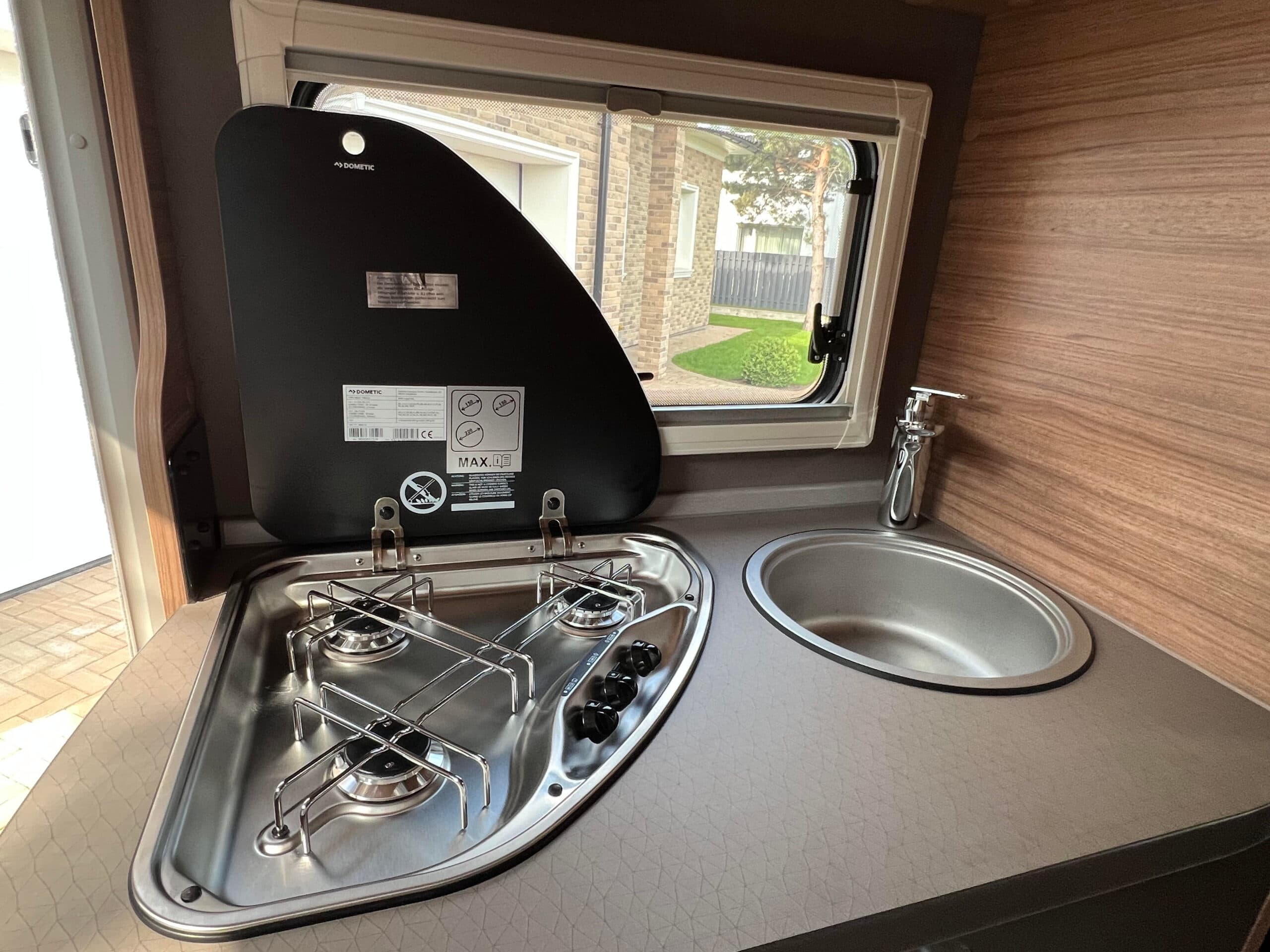
Every Puikūs Kemperiai camper is rented with all its equipment included in the price, so there is nothing extra to arrange before a trip around Europe: a 100-litre water tank, a hob, a fridge, a shower, a toilet, an awning, outdoor furniture and a bike rack. The rental price includes comprehensive (KASKO) insurance with an 800 EUR unconditional excess (deductible) and an 800 EUR deposit, and the daily price ranges from 95 to 270 EUR, depending on the season and the length of the rental. The company has 28 years of experience and delivers campers to any town or city in Lithuania (Vilnius, Kaunas, Klaipėda, Šiauliai, Panevėžys and others), so you can start your trip wherever suits you. The difference between berths and seats matters most when choosing a camper for a larger group, for example 4–7 people.
Summary
There is no single 'best camper for Europe'. The right vehicle depends on your particular group, the roads on your particular route and the driving licence you hold, and these three factors often pull in opposite directions. A family that needs seven berths cannot also expect the most compact camper, one that is easy to park in a city. The trade-offs covered here will help you choose deliberately instead of by stereotype. If in doubt, a 6–7 metre semi-integrated camper is the choice that demands the fewest compromises on a mixed European route.
FAQ
Which camper is best for a trip around Europe?
For a mixed European route covering mountains, cities and coast, the best all-round choice is a 6–7 metre semi-integrated camper. It weighs no more than 3,500 kg, so a category B driving licence is enough, it sleeps two to four people, and on narrow roads it is easier to drive than a taller alcove or a larger integrated camper.
What driving licence do you need to drive a camper in Europe?
A standard category B licence lets you drive any camper whose maximum authorised mass does not exceed 3,500 kg. Almost all rental campers are built to stay within this limit, so most travellers need no additional licence. Above 3,500 kg you would need category C1, which is rare in rental fleets.
What are the main camper types?
There are four types: van camper (van), alcove, semi-integrated and integrated. They differ in how they trade the number of berths against ease of driving and parking. Vans are the most compact; alcove campers have the most berths; the semi-integrated is the balanced all-rounder; the integrated is the largest and most comfortable.
What size of camper should I choose?
Choose by the number of travellers and the route. Couples and city trips suit a compact van camper or a shorter semi-integrated camper of about 5.5–6.5 metres. Families who need five to seven berths suit an alcove camper of about 6.5–7.5 metres. Long trips where comfort matters most suit an integrated camper of 7 metres or more, accepting that parking will be harder.
What is the difference between berths and seats in a camper?
Berths tell you how many people can sleep in the camper. Seats with seat belts tell you how many people can legally travel while the camper is moving. The two numbers often differ, so a 7-berth camper may have fewer registered seats. Before you book, check that both numbers match the size of your group.
Do you need to book campsites in advance for a trip around Europe?
Yes, in the peak months of July and August. Popular coastal and Alpine campsites fill up early in summer, so book your pitches in advance for those months. Outside the peak you will have more flexibility. A stopover app such as park4night helps you find legal overnight spots and water and waste-water service points along the way.