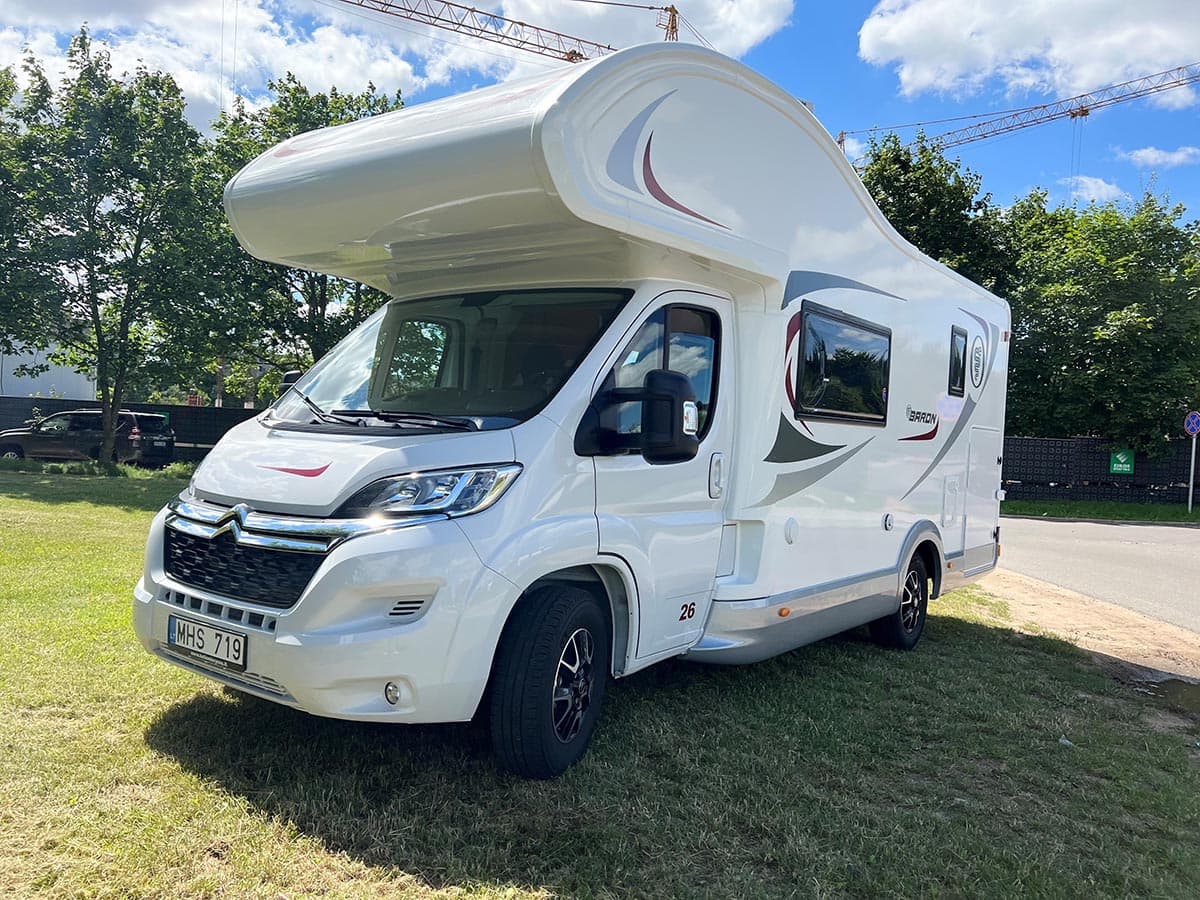
Before you sign a camper rental agreement in Lithuania, check seven terms: the deposit and what has to be done for you to get it back, what the insurance covers, the payment schedule, the condition the camper must be returned in, which countries the insurance cover applies in, whether the distance you can drive is limited, and who is allowed to drive. The rental price of our brand, Puikūs Kemperiai, already includes Comprehensive (KASKO) insurance, and the 800 EUR deposit is held on a credit card at handover unless agreed otherwise. The deposit is returned when the camper is brought back working, undamaged, clean and with a full fuel tank. The rental agreement takes effect once the 30 % booking fee is paid, and the remaining amount must be paid at least 14 days before the rental starts. The driver needs at least 3 years of driving experience and a category B driving licence.
Why the agreement decides how much you pay
A reliable rental company and a well-drafted agreement are not the same thing. Reputation shows who is likely to act fairly when something goes wrong, and the guide on how to recognise a reliable camper rental company will help you spot those signals. The agreement states exactly what will happen, and it is the only part of the deal that a court or a bank would assess if it came to that.
Seven terms decide almost every dispute in this market, and all of them can be read in a few minutes. Read them and you will know which figures are fixed and which you still need to ask about. Skip them and you are relying on goodwill alone, not on written commitments.
What should you check in a camper rental agreement before you sign?
| Term | Question it answers | What our agreement says | Why it decides the money |
|---|---|---|---|
| Deposit | How much of your money is held during the trip | 800 EUR, held on a credit card at handover unless agreed otherwise | Returned in full only if all the return conditions are met |
| Insurance | What is insured while you drive | KASKO included in the rental price; third-party liability insurance with a Green Card, issued by us as the lessor | Decides who pays for damage and what share |
| Payment schedule | When each amount is due | 30 % booking fee, balance paid at least 14 days before the start, deposit held at handover | Sets when the booking becomes binding |
| Return condition | What "properly returned" means | Working, undamaged, clean, with a full fuel tank | Decides whether the deposit is returned |
| Territory | Which countries you can travel to | Trips abroad allowed where the insurance cover applies | Decides whether you are insured abroad |
| Mileage | Whether the distance you can drive is limited | Not stated in our terms, ask before you sign | An exceeded limit is charged after the trip, not before it |
| Driver eligibility | Who is legally allowed to drive the camper | At least 3 years of driving experience, category B driving licence | Breaching this term can void the insurance cover |
Each row is a figure or a term you can ask the lessor for. If a company cannot give it to you in writing, the term has not been finally agreed yet.
What is the deposit and when will you get it back?
The deposit is a sum of money that the rental company holds for the rental period as a guarantee that the vehicle will be returned in the agreed condition. It is not a service fee. The deposit is returned in full when the conditions set out in the agreement are met.
Our deposit is 800 EUR. It is held on a credit card at handover unless agreed otherwise, and returned when the camper is brought back working, undamaged, clean and with a full fuel tank. These four conditions are the basis for assessing the camper's condition. That is exactly why it matters to read the return conditions carefully rather than just skim them: everything that could lead to part of the money being deducted is written there.
Compare this figure across companies, because it is money held on your account for the whole trip, and it has to be available on the day of handover. According to publicly available rental terms we reviewed on 2026-07-28, deposits ranged from 800 EUR to 1500 EUR. Our deposit is 800 EUR, the bottom of that observed range. A larger deposit does not in itself mean a stricter or more serious company, so it helps to compare not just the figure but also the conditions you have to meet to get it back. Ask every company whose offer you are considering for both in writing.
When and in what instalments do you pay?
| Stage | What you pay | When |
|---|---|---|
| Booking | 30 % booking fee | The rental agreement takes effect once it is paid |
| Before the trip | The rest of the rental price | At least 14 days before the rental starts |
| Handover | 800 EUR deposit, held on a credit card unless agreed otherwise | The same day you collect the camper |
| Return | Nothing, if the return conditions are met | The deposit is released |
The table shows three separate stages. The booking fee is what turns an enquiry into an agreement, so this is the moment when the terms discussed become binding on both sides. Read them before you make this transfer. The balance has a fixed deadline: our terms require the full rental payment to reach the company's account at least 14 days before the rental starts.
We publish the schedule on our terms page, so you can read it before you even make a booking. Apply the same rule anywhere you get an offer: if the payment schedule only becomes clear after you have committed, you lose the chance to negotiate it.
What exactly is frozen on your card, and when is the hold released?
The 800 EUR deposit is held on a credit card at handover unless agreed otherwise. A hold means the amount is frozen and unavailable to you, but it is not transferred to us: your bank still shows it as your money, only held. When the camper is returned working, undamaged, clean and with a full fuel tank, the hold is released.
Your card needs 800 EUR of available limit on top of the rental amount itself. This often surprises people who use debit cards with low daily limits. Releasing the funds is both a banking and a rental operation, so the amount becomes available again when your card issuer processes it, not necessarily the minute you hand back the keys. At handover, ask which card the hold will be placed on and when it will be released, and once the trip is over, get written confirmation.
What does "returned clean, with a full fuel tank" actually mean?
This is the term that decides whether the deposit is returned, so take it literally. The camper leaves with a full fuel tank and comes back with a full fuel tank. It is returned clean, undamaged and in good working order. The waste water and toilet tanks must be emptied. None of these requirements is unusual in the market. Companies differ only in whether they charge you if they have to do these jobs for you.
This term is where the extra charges typical of the market sit. Cleaning fees, refuelling surcharges and daily mileage overruns are charged after the trip out of money the company has already held. None of these charges is unlawful, and a company that states them clearly before you pay is acting fairly. The problem arises when you only find out about them at the return.
Plan the last hours of your trip accordingly, with a refuelling stop and a camper service point near the return location on your route.
Who pays if a window cracks or a tyre bursts?
Comprehensive (KASKO) insurance is included in our rental price and covers damage to the camper itself. Whether a cracked window is an insured event depends on the policy: glass, roof hatches and skylights are usually insured under certain conditions rather than automatically, so the answer depends on the specific policy for the specific camper. Tyres are a separate question, and our terms do not define this in detail: where the policy does not cover it, the cost is settled under the rental agreement.
The rental terms pages state that KASKO is included, but they do not list which specific camper parts the policy treats as insured. The insurance company If, writing about camper trips on 2026-06-30, advises renters to ask specifically whether and under what conditions glass, roof hatches, skylights, the awning and other additional equipment are insured, whether theft, natural forces and collisions with animals are included, and what the limits are for insuring personal belongings. These are parts of a camper, not of a passenger car, so a standard vehicle policy summary will not answer these questions.
Ask at handover. Our camper handover takes up to an hour, and that time is set aside precisely so that the water system, appliances, equipment and terms can be discussed standing next to the vehicle. Ask these questions on the spot and get the answers in writing.
If an insured event does happen, the next thing that matters is how the repair goes. We have our own service centre in Vilnius, so faults in the campers of our fleet are diagnosed and fixed on site, not while waiting in a queue at someone else's workshop. Roadside assistance is available around the clock.
What does the agreement say about driving abroad?
Trips abroad are allowed. Third-party liability insurance with a Green Card is issued by us as the lessor. The main condition is that the destination country must be included in the insurance cover. Where it does not apply, arranging and paying for insurance is the renter's responsibility. This is a term to clear up before you plan your route, not at the border.
Checking it takes just a minute. The Green Card system covers 46 countries, and in Lithuania it is administered by the Motor Insurers' Bureau of the Republic of Lithuania. According to its guidance for travellers (checked 2026-07-28), Lithuanian compulsory motor third-party liability insurance applies without a separate Green Card throughout the European Economic Area and Switzerland, as well as in Andorra, Bosnia and Herzegovina, Serbia, Montenegro and the United Kingdom. Outside this list a Green Card is required, which covers destinations such as Turkey, Ukraine, Morocco and Tunisia. Countries' membership status changes, so always check the current situation on the institution's official list. This applies to this page as much as to any other source.
For the vast majority of trips from Lithuania, which run through Poland, Germany, Austria, Italy, France or Scandinavia, this means one thing: you are insured and there is nothing extra to arrange. This term becomes important when travelling to the edges of the map, so be sure to check it if your route goes beyond the list above.
Is there a mileage limit?
Our terms do not state a mileage limit, so before you sign, ask for this term in writing and get an answer as a figure or a clear confirmation that there is no limit.
Do ask, because limits definitely exist in this market. Among the Lithuanian rental terms we reviewed on 2026-07-28, a limit of about 500 km per day, calculated as an average over the whole rental period, was a frequently recurring provision, along with minimum rental periods and a minimum driver age. Average limits are easy to misread: two weeks at 500 km per day comes to 7000 km in total. That is generous for a trip around the Baltic states, but on the low side for a return trip to southern Spain. Before you sign the agreement, work out your route in kilometres and compare it with this term.
Who is allowed to drive it?
Our terms require at least 3 years of driving experience and a category B driving licence. Read the wording carefully, because it applies to whoever is driving, not only to whoever signs the agreement. The terms state that the rented vehicle may be driven by a person with the relevant experience and category. So a partner or friend who takes over the driving on a long stretch must meet the same requirement as the person named in the agreement.
Category B covers vehicles with a maximum permitted mass of up to 3500 kg. That is what most campers in Lithuanian rental fleets are, ours included. Clear this up before you book, not at handover. If someone in your group does not meet the requirements, the practical consequence is not just an administrative offence. Driving in breach of the agreement's terms is one of the standard reasons an insurance claim is rejected, which means the whole repair bill will fall on you.
What to ask for in writing before you pay anything
Six questions a reliable company can answer in a minute:
-
Ask for all the written terms and the rental agreement you will sign before you pay the booking fee.
-
The deposit amount and its return conditions, together with the payment schedule dates, including how many days before the start of the trip the balance must be paid. In our case it is 14 days.
-
The mileage terms, given as a figure or a clear confirmation that there is no limit.
-
Information on what exactly the insurance covers in the camper: glass, roof hatches, the awning, additional equipment, theft, personal belongings.
-
The driver requirements: minimum driving experience, licence category and whether every driver must be named in the agreement.
-
The details of the legal entity behind the brand name, so you can check the company yourself.
The last point is the quickest check there is, yet almost nobody does it. The brand name is what the company calls itself. The company code is how the state identifies it, and it is linked to its accounts, address and date of incorporation. Puikūs Kemperiai is a brand of UAB Kertušas, company code 121253292, VAT code LT212532917, registered at Kirtimų g. 2, K4, LT-02300 Vilnius. The company has 28 years of experience, a fleet of about 29 campers and a service centre at the same address. Anyone can confirm this in the Lithuanian Register of Legal Entities in less than a minute, without even asking us.
If a company does not provide its terms in writing before payment, does not state the deposit and its return conditions, or does not name its legal entity, that does not yet prove bad intent. But it signals that the answers do not exist in a fixed form, which means they may be decided later, in the company's own favour, out of money it has already held.
What does reading the agreement not protect you from?
A carefully read agreement helps you avoid financial surprises, but it does not remove every risk. Insurance policies have exclusions that no rental terms page fully sums up, damage assessment involves subjectivity, and two companies can write the same term and apply it differently. What reading the agreement gives you is a fixed set of figures you can rely on: a known deposit, a clear return standard, a specific payment schedule and a defined territory.
Some terms can be negotiated individually, so the right step is to ask before you sign the agreement and get the answer in writing. You can find out how much rental costs in different seasons and depending on its length on our 2026 camper rental prices page, which sets out the publicly listed rates.
FAQ
What should I check in a camper rental agreement before I sign?
Check seven terms: the deposit amount and its return conditions, what the insurance covers, the payment schedule, the return condition, which countries the insurance cover applies in, the mileage term and the driver requirements. In our case it reads like this: an 800 EUR deposit, held on a credit card at handover unless agreed otherwise; Comprehensive (KASKO) insurance included in the rental price; a 30 % booking fee, with the balance paid at least 14 days before the start; the camper returned working, undamaged, clean and with a full fuel tank; trips abroad allowed where the insurance cover applies; no mileage limit stated in our terms, and the driver must have at least 3 years of driving experience and a category B licence.
What is a camper rental deposit and what is it for?
The deposit is money that the rental company holds during the rental as a guarantee that the camper will be returned in the agreed condition. It is not a service fee. The Puikūs Kemperiai deposit is 800 EUR; it is held on a credit card at handover unless agreed otherwise, and returned when the camper is brought back working, undamaged, clean and with a full fuel tank.
How large is a camper rental deposit in Lithuania?
Our deposit is 800 EUR; it is held at handover and returned when the camper is brought back working, undamaged, clean and with a full fuel tank. According to publicly available Lithuanian rental terms reviewed on 2026-07-28, deposits ranged from 800 EUR to 1500 EUR.
Is KASKO insurance included in the rental price?
Yes. Comprehensive (KASKO) insurance is included in our rental price and covers damage to the camper itself. This is different from third-party liability insurance, which covers damage you cause to others. The 800 EUR deposit is a separate amount, held on a credit card at handover unless agreed otherwise, and returned when the camper is brought back working, undamaged, clean and with a full fuel tank.
When is the deposit returned?
The 800 EUR deposit is returned when the camper is brought back in the agreed condition: working, undamaged, clean and with a full fuel tank. The hold is released by your card issuer once the return is accepted, so the amount becomes available again on the issuer's timescale, not the moment you hand over the keys.
When must the rest of the rental amount be paid?
The 30 % booking fee makes the agreement valid. The rest of the rental price must reach our company's account at least 14 days before the rental starts. The 800 EUR deposit is held later, at handover.
Who is allowed to drive a rented camper?
Our terms require at least 3 years of driving experience and a category B licence, which covers campers with a maximum permitted mass of up to 3500 kg. This requirement applies to everyone who drives the camper, not only to the person who signs the agreement. Driver eligibility is worth checking at every company you compare, because driving in breach of the agreement's terms can void the insurance cover.
Can I drive a rented camper abroad?
Yes. Trips abroad are allowed, and as the lessor we issue third-party liability insurance with a Green Card, provided the destination country is included in the insurance cover. Lithuanian compulsory motor third-party liability insurance applies without a separate Green Card throughout the European Economic Area and Switzerland, as well as in Andorra, Bosnia and Herzegovina, Serbia, Montenegro and the United Kingdom (Motor Insurers' Bureau of the Republic of Lithuania, checked 2026-07-28). For countries not on the list of insured countries, the renter arranges and pays for the insurance.
Is there a mileage limit on a rented camper?
Our terms do not state a mileage limit, so before you sign, ask for this term in writing and get an answer as a figure or a clear confirmation that there is no limit. In the wider Lithuanian market, publicly available terms include limits of about 500 km per day, calculated as an average over the rental period, so this question is worth asking every company you compare.
How do I check that a rental company is a real registered business?
Ask for the name of the legal entity and the company code, then check it in the Lithuanian Register of Legal Entities. Puikūs Kemperiai is a brand of UAB Kertušas, company code 121253292, based at Kirtimų g. 2, K4, LT-02300 Vilnius. A company that does not name its legal entity fails the very simplest check.
About. Puikūs Kemperiai (UAB Kertušas) is a camper rental company with 28 years of experience and its own service centre in Vilnius. Contact: +370 684 35550. Last updated 2026-07-28.
Sources
- Puikūs Kemperiai rental terms (puikuskemperiai.lt/salygos), primary source, read 2026-07-28: 30 % booking fee, the full rental payment must be made at least 14 days before the rental starts, 800 EUR deposit held on a credit card at handover unless agreed otherwise and returned when the vehicle is returned working, without additional defects, clean and with a full fuel tank, KASKO included, the rented vehicle may be driven by a person with at least 3 years of driving experience and a category B licence, full tank on departure and return, Green Card third-party liability insurance issued by the lessor, no mileage limit stated.
- Puikūs Kemperiai, "How to choose a camper rental company" (puikuskemperiai.lt/kaip-issirinkti-kemperiu-nuomos-imone), primary source, read 2026-07-28: campers are rented with KASKO insurance included.
- Puikūs Kemperiai FAQ (puikuskemperiai.lt/duk), primary source, read 2026-07-28: 24/7 roadside assistance and the company's own service centre in Vilnius.
- Puikūs Kemperiai contacts page (puikuskemperiai.lt/kontaktai), primary source, read 2026-07-28: UAB Kertušas, company code 121253292, VAT code LT212532917, Kirtimų g. 2, K4, LT-02300 Vilnius, +370 684 35550.
- Motor Insurers' Bureau of the Republic of Lithuania (cab.lt), guidance for travellers abroad, checked 2026-07-28: the Green Card system applies in 46 countries; Lithuanian compulsory motor third-party liability insurance applies without a Green Card in the European Economic Area, Switzerland, Andorra, Bosnia and Herzegovina, Serbia, Montenegro and the United Kingdom.
- If P&C Insurance, "Planning a camper trip? What you need to know", published 2026-06-30, checked 2026-07-28: what to check about glass, roof hatches, the awning and additional equipment, theft, natural forces, collisions with animals, personal belongings limits and roadside assistance.
- Publicly available rental terms of Lithuanian camper rental companies, reviewed 2026-07-28: deposits from 800 EUR to 1500 EUR, daily mileage limits of about 500 km calculated as an average over the rental period, minimum rental periods and a minimum driver age. Individual companies are not named.